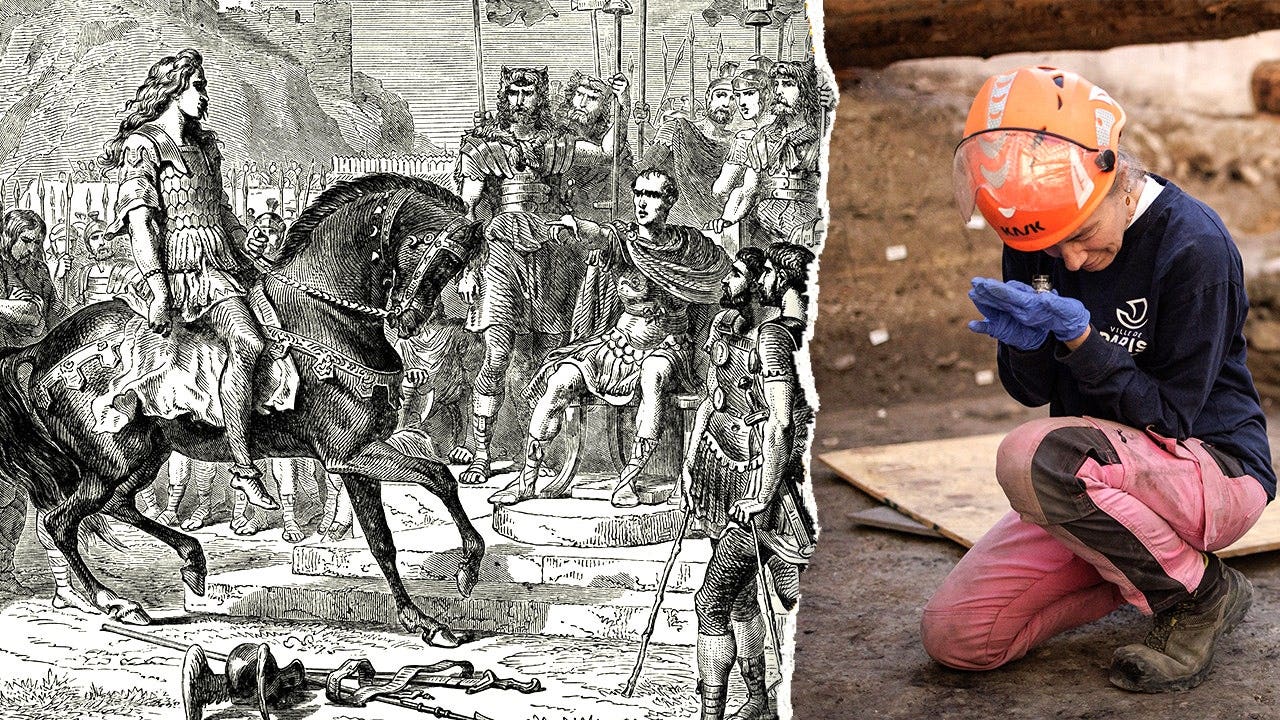
Archaeologists in Paris have uncovered an ancient wall that may be a crucial piece in solving a centuries-old mystery dating back to the time of Julius Caesar. The discovery was announced by the French Ministry of Culture, which stated that the wall, found in the courtyard of the Hôtel-Dieu hospital, might have belonged to the ancient city of Lutetia.
The excavation, which began in February, was conducted ahead of a major redevelopment project in the area. Initially, researchers expected to find remains from the medieval and early modern periods, but instead discovered a stone-and-timber wall characteristic of ancient Gallic fortifications. The wall, which stretches approximately 66 feet, bears evidence of a major fire and radiocarbon testing suggests that the wooden elements found at the site date to between 200 B.C. and 10 B.C.
Researchers believe the structure may have served as a defensive fortification for the Gauls. The wall's stonework showed signs of fire damage, and archaeologists uncovered burned seeds and the remains of a charred wooden building nearby. Caesar's account indicated that the Gallic Parisii tribe burned its own fortified settlement in 52 B.C. to prevent it from falling into Roman hands.
According to officials, the discovery of the wall and its archaeological context may finally solve the mystery of Lutetia's location. "Today, with this wall and its archaeological context, we may finally hold the key to solving the mystery," said Dorothée Chaoui-Derieux, a Paris archaeology official.
Due to the redevelopment project, the ancient wall cannot remain at its original location. Researchers plan to reconstruct part of the wall using original stones, with hopes of eventually displaying it in a Paris museum. Further excavations will be conducted to determine the wall's age and purpose, and to investigate the platform behind the structure and any remains buried beneath it.
NTC Report coverage is based on reporting from the original publisher.
View original reporting →